Mátyás Erményi
Woodlouse
| Venue: | acb Attachment |
| Date: | Mar 13 – Apr 17, 2026 |
| Opening: | Mar 12, 2026, 18:00–21:00 |
Description
At his third solo exhibition, Mátyás Erményi presents new works that delve ever more deeply into the layered terrain of Eastern European visual memory. Within a world shaped by the aesthetics of Central and Eastern European animated films and the motifs of post-socialist material culture, everyday forms—stoves, chandeliers, plants, portraits, or books—transform into anthropomorphic characters that simultaneously carry childlike playfulness and the ambivalent weight of nostalgia. In his newest series, this investigation takes a new direction as the painterly universe extends beyond the flat surface of the canvas: figures and motifs familiar from the paintings take on physical form in ceramics and in a shelf installation.
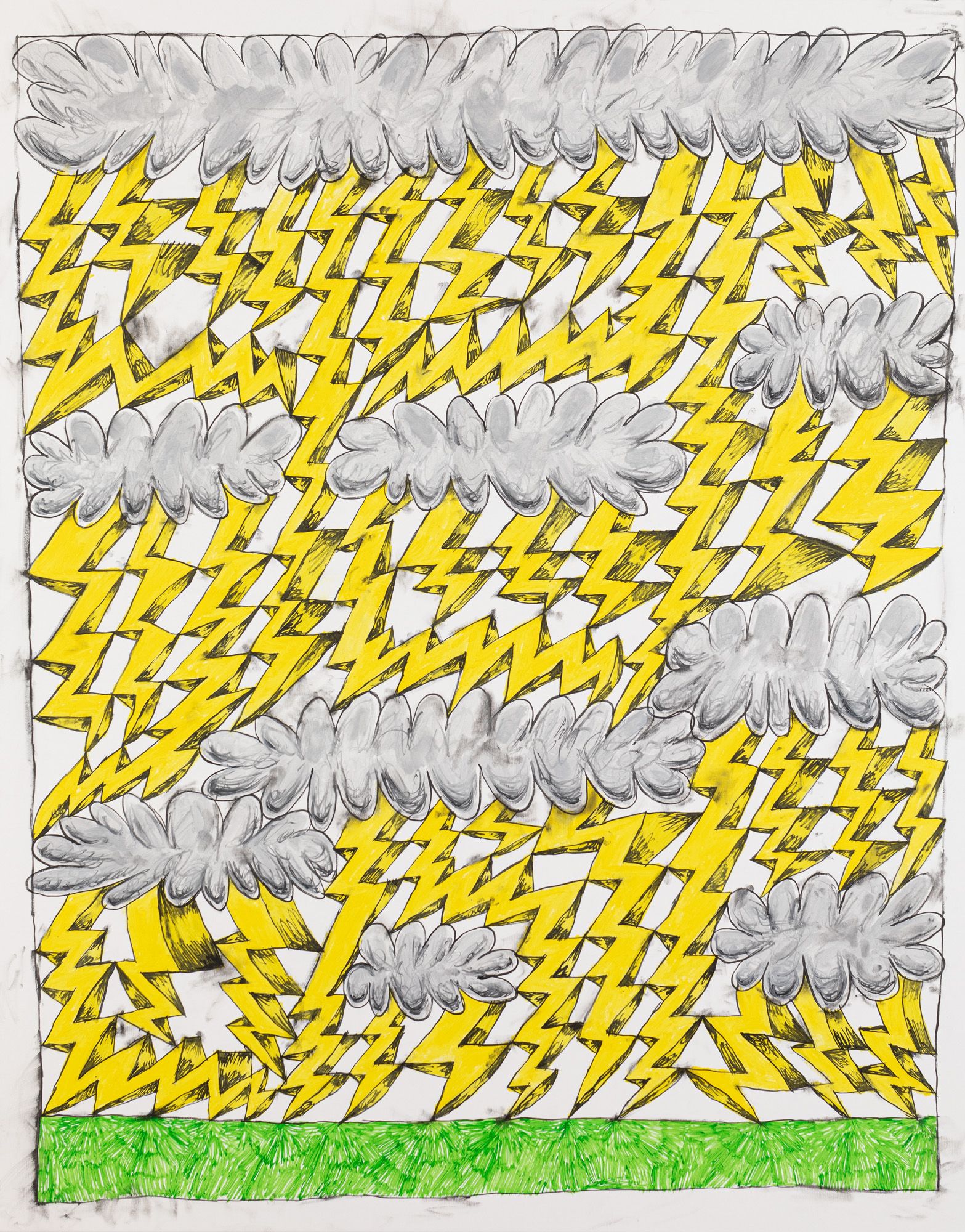
Yet painting remains at the center of the exhibition. Working with brush and acrylic, Erményi nevertheless creates drawing-like, layered surfaces in which landscape fragments connect with stamp-like portraits and nostalgic figures. Memories of the landscape of Máriaremete, family photographs forgotten in basements, Fortepan archives, iconic stills from old Hungarian films, or the linearity of VHS-era screens all serve as visual sources from which his own temporal strata are constructed. His themes coalesce from diverse motifs into unified compositions—much like the collected objects of ancestral gatherers arranged in a vitrine, or a wunderkammer assembled from memories in 2026. The dots, frames, and button-like elements appearing on the canvases also allude to the control panels and image frames of old television sets, as well as to border decorations and ornamental pattern sequences known from folk art, while simultaneously marking the limits of painting itself: they reflect both the physical frame of the image and the structured nature of the viewer’s memory.
The ceramics placed throughout the space—marching soldiers, nails, mushrooms, eyes, vases, and glasses—appear as characters stepping out of the paintings. These objects are not merely installative elements but extensions of painterly thinking: three-dimensional variations of repetitive motifs that function as small icons of collective memory. The figures simultaneously evoke the ornamentation of folk art, the playful narrativity of comics, and the melancholic undertones of wartime or military iconography.
Erményi’s paintings may also be read as a form of time travel. Blurred biographical memories, faded apple pickers, or soldier portraits recalling postcards evoke images of the past that can no longer be reconstructed precisely, only reinterpreted. Here painting operates as a kind of personal and collective constellation of family memory: transgenerational stories and traumas unfold beneath the surface of humor and cartoon-like forms, while repetition becomes a gesture of processing.
Ultimately, the exhibition raises the question of whether the personal past can be understood from the perspective of the present, relying solely on the accounts of witnesses and material traces. Erményi’s answer remains deliberately ambiguous: the paintings instead open passageways for the viewer where personal memories and a shared Eastern European visual heritage begin to overlap. The works both document and rewrite time, while ordinary figures gradually emerge as quiet heroes—characters who continue to live within family memory, even if their stories survive only in fragments.