Csaba Nemes
Painting as Shelter
| Venue: | acb Gallery |
| Date: | Mar 13 – Apr 17, 2026 |
| Opening: | Mar 12, 2026, 18:00–21:00 |
Description
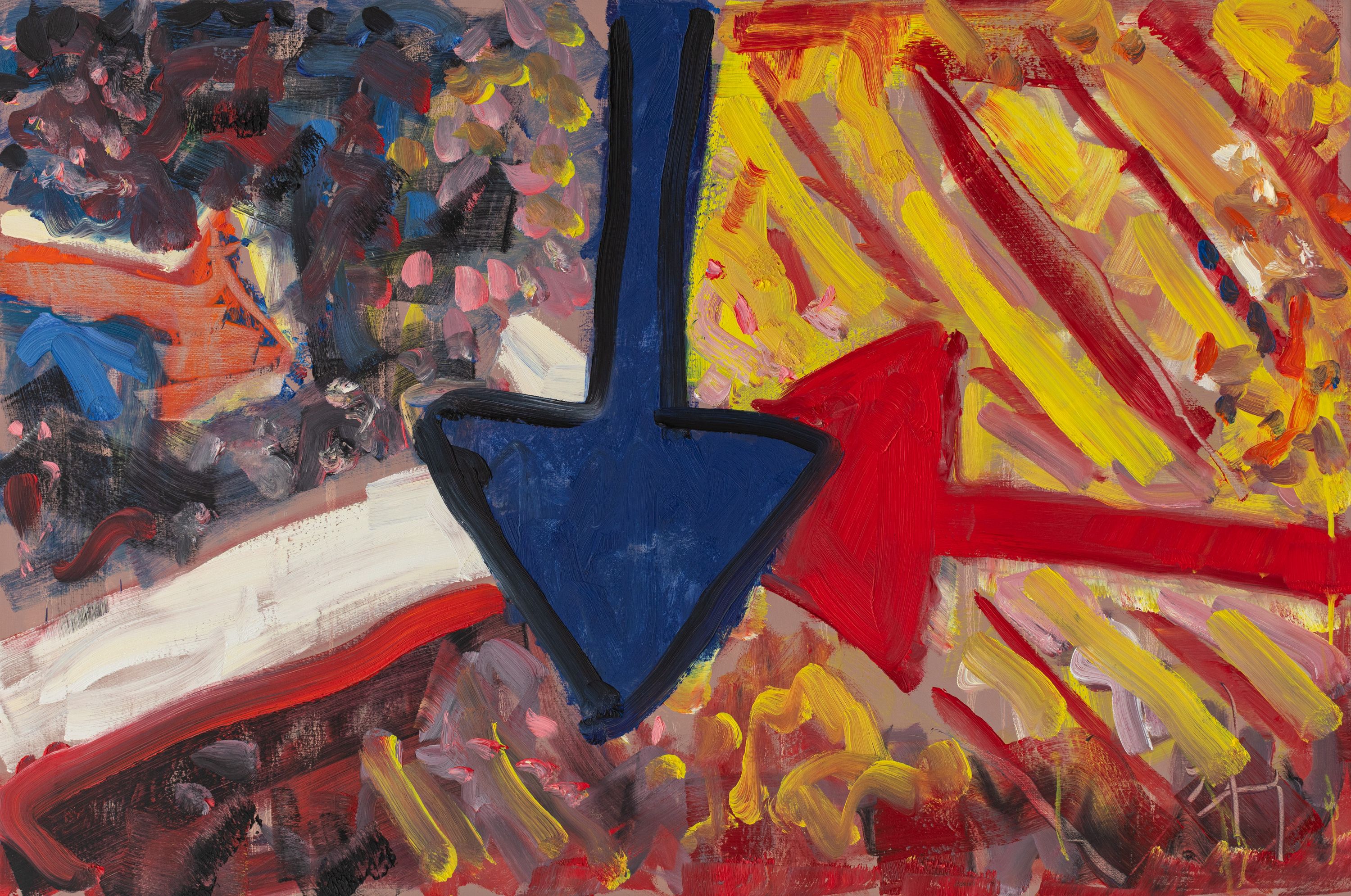
Two years after his introductory exhibition, Csaba Nemes returns to acb Gallery with a new solo show titled Painting as Shelter. The exhibition presents a selection from his most recent painting cycles, which both consistently build upon and move beyond the selections from the series Making Painting (2023) and Appearance (2022). These works mark a new and distinctive trajectory within the artist’s abstract painting program launched in 2020.
Similarly to the previous cycles, the newest works are characterized by free, densely applied and layered improvisational gestures, thick paint material, scraping back, and a compositional logic based on contrasts and complementarities. At the same time, the defining motifs of Nemes’s earlier series—abstract signs, arrows, vectors, scratched grids, brick walls, and flag-like constructions—appear to almost completely dissolve within an explosive, elemental pictorial language driven primarily by gesture. This aesthetic program shows affinities, on the one hand, with postwar abstract expressionism, Tachisme, and Art Informel, and on the other—or perhaps even more strongly—with the New Wild painting and neo-expressionism of the 1970s and 1980s, which rewilded contemporary art following the concept art of the 1960s.
Accordingly, the title Painting as Shelter designates painting not as a representational but as an operative space: a sensuous, materially oriented, gesture-based practice that provides the subject with a temporary refuge from the political and visual overload of late modernity, as well as from the anesthetizing, numbing, and passivizing regimes of vision characteristic of techno-capitalist realism. Within this framework, the expressive painterly language reactivated in the spirit of Neue Wilde Malerei and related tendencies—and the broader, potentially utopian image-political program that may follow from it—should not be understood as a return, but rather as a strategy of resistance. Exaggerated gesture, condensed material use, and the destructive treatment of the surface restore the autonomy of painting not in an aesthetic but in an existential sense.
The painting thus functions not merely as an image but as a threshold surface: it simultaneously separates and connects subjective experience with the structural forces of the external world. The metaphor of shelter outlined in the title does not denote a closed state of protection, but rather a dynamic, unstable condition that is constantly renegotiated—one that both bursts forth from the surface of the painting and propels the viewer back into the immediate, sensuous materiality of the picture field and the elemental experience of painting itself. The viewer’s gaze is thus compelled into a constantly shifting, staccato-like scanning movement, while the image offers no stable resting point from which the totality of the visual field could be objectified and possessed.
Painting as Shelter also interprets painting as an emotional and psychological refuge. The densely layered paint material evokes sensations of protection and isolation, while the repetitive gestures may be read as strategies of self-defense and endurance. In line with the tradition of abstract expressionism, Nemes’s new paintings organize the pictorial surface through the continuous tension between control and chaos, containment and exposure: more closed forms, reinforced contours, and condensed zones function as temporary shelters, while explosive gestures erupting from the surface render visible experiences of vulnerability and threat. In this sense, the painterly gesture is not merely expressive but also defensive. The impasto application of paint forms armor-like layers, while scraping back, erasure, and repainting become visual practices of concealment, self-correction, and self-preservation.
Csaba Nemes graduated from the Hungarian University of Fine Arts in 1989 with a degree in painting and is currently a newly appointed professor at the Department of Painting at the University of Pécs. His works are included in the collections of, among others, the Centre Pompidou in Paris, the Albertina in Vienna, MOCAK in Kraków, the Ludwig Museum in Budapest, and the Hungarian National Gallery. In 2013 he received the Leopold Bloom Art Award and previously participated in the São Paulo Biennial. In 2023 he presented a large-scale solo exhibition together with Dia Zékány at the Emil Schumacher Museum in Hagen. His work has also been exhibited at M21 in Pécs, MOCAK in Kraków, MMSU in Rijeka, the House of Arts in Ústí nad Labem, and the Institute of Contemporary Art in Dunaújváros. In May 2026, a major retrospective exhibition will open at MODEM in Debrecen, offering insight into more than three decades of his artistic practice and its most significant milestones.