Klaudia Januško
Served Right
| Venue: | acb IMRE BAK space |
| Date: | May 05 – 29, 2026 |
| Opening: | Apr 30, 2026, 18:00–21:00 |
Description
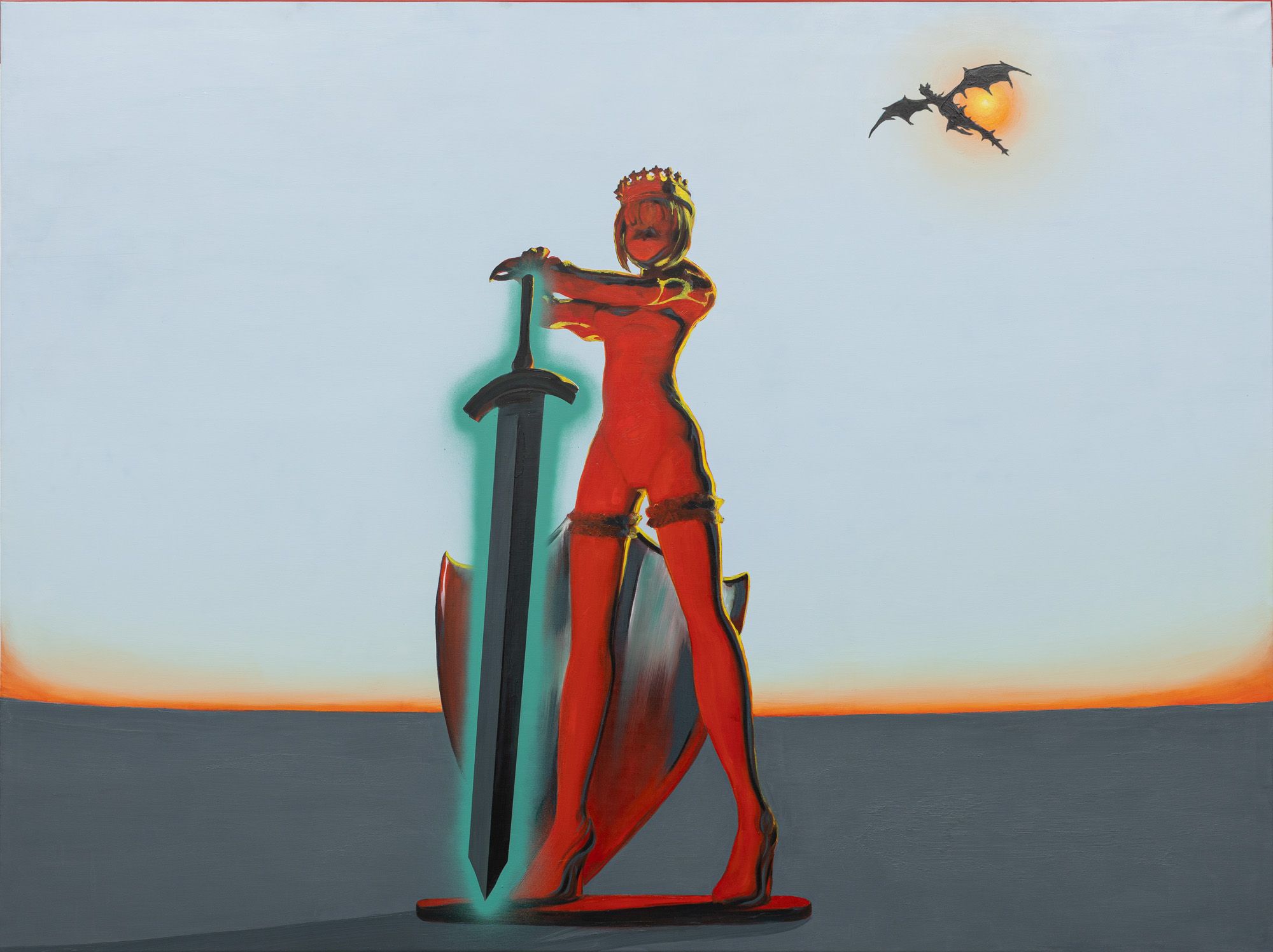
Klaudia Januško’s second solo exhibition at acb Gallery, titled Served Right, opens in the Imre Bak space. In her earlier works, Januško examined the objectifying visual logic of the culturally ingrained male gaze and the socio-psychological structures that sustain it. In this new exhibition, the emphasis shifts toward the intersection of multiple theoretical approaches. From the perspective of radical feminism, she explores inequalities embedded in everyday life; through cyberfeminism, she rethinks gender relations in digital spaces and technologies; while neomedievalism employs stylized images of the past—especially the Middle Ages—to reflect on contemporary systems of power. In the background of this line of thought, Valerie Solanas’s SCUM Manifesto is evoked with ironic and critical distance, raising the question: what material and visual traces might remain of such an imagined uprising? These perspectives do not appear as separate frameworks, but as overlapping layers of thought that continuously rearrange one another.
The title Served Right itself carries this multilayered meaning: it simultaneously refers to someone “getting what they deserve” and to the historically gendered role of care and service associated with women. In this reading, domestic labor is not merely a sign of subordination, but also a space where possibilities of strength and resistance can emerge. The exhibition functions as a kind of imaginary journey through space and time, where narratives related to the female body, labor, and power are reconfigured. The space creates the impression of entering a fictional archive or a small museum, where objects from a lost, woman-centered world appear in a storage-like yet carefully composed arrangement. This situation places the viewer in an interpretive position rather than that of a passive observer.
Rolling pins of various sizes, detached from the wall and paired with antique knife rests, reinforce this shift. Everyday tools step outside their usual functions: they appear simultaneously as utilitarian objects, ritual artifacts, and weapon-like forms. The shiny metal surfaces and precisely constructed installation evoke the authenticity of museum display, while operating according to an invented historical logic. The meaning of the objects is not fixed but constantly changing. A rolling pin can be a tool, a memory, or a symbol depending on the perspective from which it is viewed. The weapon-like arrangement is not illustrative but rather a displacement of meaning: domestic objects here seem like extensions of the body, carrying the potential for defense and resistance. In this temporally unstable and shifting world, the visual language of neomedievalism also becomes prominent. Stylized, medieval references to the past do not represent nostalgic return, but rather offer an alternative perspective through which contemporary power relations can be reconsidered.
The archival structure of the exhibition raises the question of what is deemed worthy of preservation and which stories are excluded from collective memory. The exhibition space is not neutral, but the result of selection and arrangement. In contrast, the fictional archive outlines an alternative order in which female experience appears not as absence but as a point of departure. In this way, the past is not a closed narrative but a possible viewpoint, reminding us that knowledge is always situated. The exhibition does not offer definitive interpretations, but opens a space in which the present itself can be rethought. In the representation of objects and the body, it becomes particularly significant that things are not passive: they seem to look back, thereby unsettling the viewer’s own position. Served Right is thus not a conventional exhibition, but rather a space for thinking—a situation in which the meanings of everyday objects shift, and where imagined narratives of the past help reinterpret the workings of the present without fixing a single, final reading.
Klaudia Januško (b. 1998) graduated from the Hungarian University of Fine Arts with an MA in Painting in 2024, and in 2023 studied at Aalto University in Finland through the Erasmus program in Visual Cultures, Curating and Contemporary Art. Her research has been supported by the Hungarian New National Excellence Program as well as the BRAWE Hungarian-Turkish international feminist collaboration initiatives. Since 2022, she has participated in numerous group exhibitions in Hungary—including at Liget Gallery, Trafó Gallery, and acb Gallery—as well as in Athens, Helsinki, Paris, and New York. In 2024, as part of the SÍM Residency curatorial practice program in Iceland, she examined the intersection of local climate change impacts and the social position of Icelandic women from an ecofeminist perspective. In 2025, she received the Kassák Contemporary Art Award and was a finalist for the TÓTalJOY Award and the ACAX & Residency Unlimited New York program. In the autumn of 2025, she spent two months on a scholarship at the Cité Internationale des Arts residency program in Paris. Most recently, she participated for two months as a fellow in the Goyki 3 artist residency program in Poland. Her second solo exhibition, Served Right, is on view at acb Gallery in the Bak Imre space.
Special thanks to Tibor Gungl, metalworker, for his professional contribution.